Understanding kVA vs kW in UPS Systems
When selecting a UPS system, one of the most misunderstood technical concepts is the difference between kVA and kW. Confusing these two measurements can lead to improper sizing, overloaded systems, reduced runtime, and unnecessary costs.
Understanding how apparent power, real power, and power factor relate to one another is essential for designing reliable and efficient power protection systems.
What Is kVA?
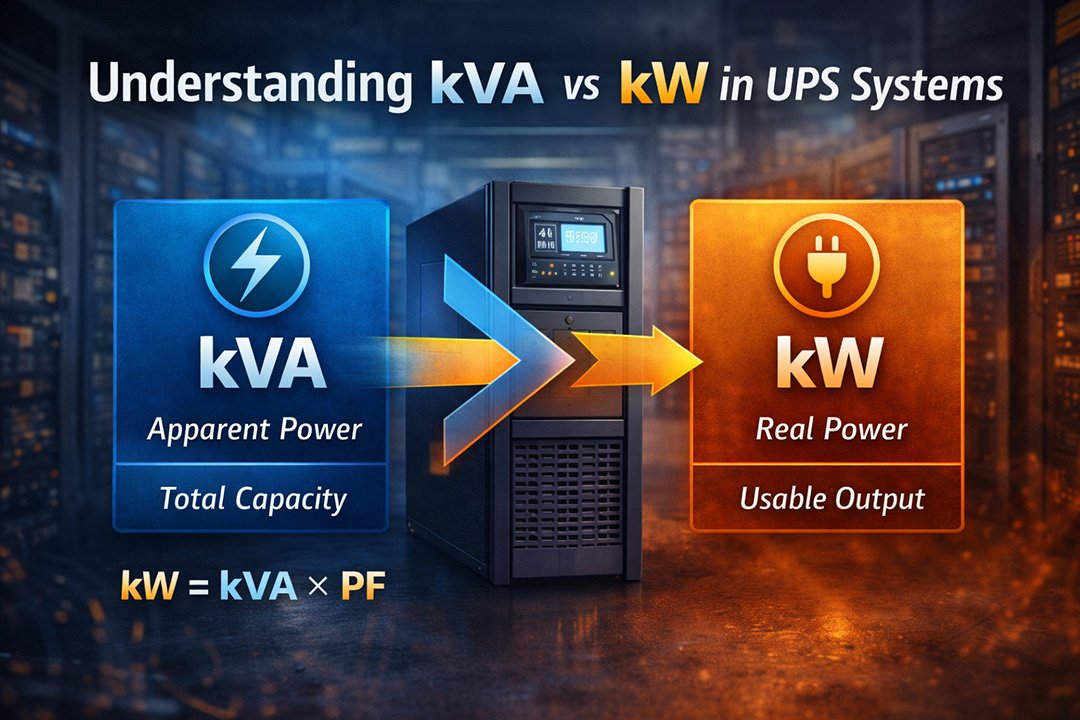
kVA stands for kilovolt-amperes and represents apparent power.
Apparent power is the total electrical capacity supplied by a UPS system. It reflects the maximum amount of power the unit can deliver, regardless of how efficiently connected equipment uses it.
In simple terms:
kVA = Total output capacity of the UPS
Manufacturers commonly list UPS ratings in kVA because it represents overall system capability.
What Is kW?
kW stands for kilowatts and represents real power.
Real power is the actual usable energy consumed by equipment to perform work. Servers, industrial machinery, medical devices, and IT infrastructure all operate based on real power.
In practical terms:
kW = Usable output power available to connected loads
When evaluating UPS systems, kW is often more important than kVA because it determines how much real workload the system can support.
The Role of Power Factor
The relationship between kVA and kW is determined by power factor.
Power Factor (PF) measures how efficiently electrical power is converted into usable work.
The formula is:
kW = kVA × Power Factor
For example:
If a UPS is rated at 10kVA with a power factor of 0.9:
10 × 0.9 = 9kW usable power
This means the system can safely support equipment requiring up to 9kW.
Why Power Factor Matters in Modern UPS Systems
Older UPS systems commonly had power factors between 0.7 and 0.8. This required oversizing the UPS to meet real power demands.
Modern double-conversion UPS systems frequently offer power factors of 0.9 or even 1.0. Higher power factor provides:
- Greater usable capacity
- Improved system efficiency
- Reduced need for oversizing
- Better return on investment
When comparing systems, always check both the kVA and kW ratings.
Common Sizing Mistakes
Mistake 1: Looking Only at kVA
Example:
Equipment load = 12kW
Selected UPS = 12kVA
Power factor = 0.8
12 × 0.8 = 9.6kW usable
The system is undersized and may overload.
Mistake 2: Ignoring Growth Capacity
Even if current load fits within limits, failing to account for future expansion can lead to early system replacement.
A 20–30 percent safety margin is recommended for most applications.
Mistake 3: Oversizing Excessively
Oversizing increases cost and may reduce efficiency at low load levels. Proper sizing balances performance, efficiency, and scalability.
Real-World Application Examples
Small IT Room
Load requirement: 4kW
UPS rating: 5kVA
Power factor: 0.9
5 × 0.9 = 4.5kW usable
Provides safe operating margin.
Industrial Application
Load requirement: 40kW
UPS rating: 50kVA
Power factor: 0.9
50 × 0.9 = 45kW usable
Allows headroom for expansion and runtime optimization.
How to Properly Size a UPS
- List all connected equipment.
- Add total wattage.
- Convert watts to kilowatts (divide by 1000).
- Select a UPS with kW capacity exceeding your total load.
- Confirm kVA rating supports required kW based on power factor.
- Add safety margin for growth.
Accurate load assessment ensures long-term reliability and performance.
Efficiency Considerations
Efficiency ratings are typically measured at 25%, 50%, 75%, and 100% load. A properly sized UPS operates within its optimal efficiency range, reducing heat generation and energy waste.
High-efficiency systems reduce operational costs over time.
Key Takeaways
- kVA represents total apparent power capacity.
- kW represents actual usable power.
- Power factor determines how much kVA converts into kW.
- Always verify both ratings when selecting a UPS.
- Proper sizing prevents overload, extends equipment life, and improves efficiency.
Understanding these principles ensures your UPS system performs reliably under normal operation and during critical power events.